
Lean Manufacturing: The "Less but Better" Philosophy on the Shop Floor
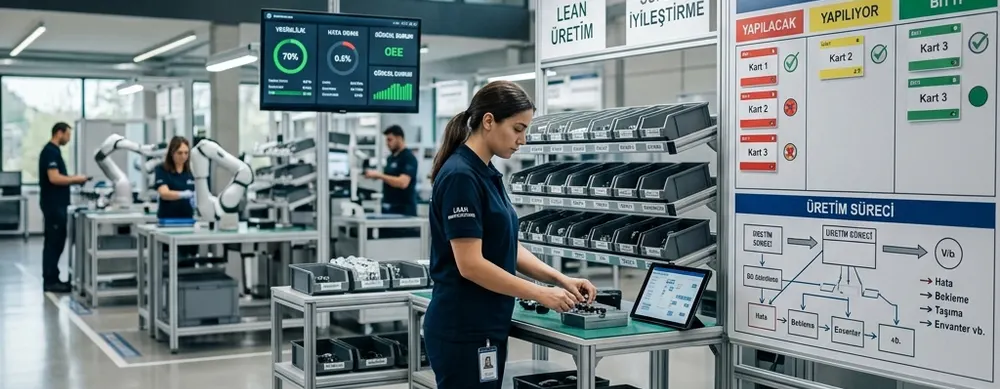
In industrial engineering, "Lean Manufacturing" usually brings to mind methodologies and Japanese words. Although the lean philosophy has many different explanations, in the simplest terms it is "simplicity".
The principle I stand by at work is "less but better". This approach sits at the very heart of lean thinking. Lean manufacturing is not about working faster or doing more in the factory; it is about working smarter, with less waste and fewer problems.
So how do I put this philosophy at the center of my work in the roles I have held?
1. Recognizing Waste (Muda) and Removing It from the Equation
The basic rule of lean thinking is to treat every step "the customer does not pay for" as waste. Examples include stock waiting in the warehouse beyond what is needed, people doing tasks that add no value, and the many procedures created just to make work look more formal. We often do these things, and many more like them, in daily life without even noticing. Eliminating this waste takes discipline. In business, waste is usually looked for only on the production floor, but in fact it should be looked for in every process from the moment something enters a company until it leaves. My job as a Planning Specialist is not only to build schedules and set stock levels, but to find the invisible waste in processes and make the system lighter.
2. Not Treating Inventory as the Solution
In traditional manufacturing, holding stock is seen as a tool for instant problem-solving. Many companies today still use stock this way, because keeping stock in front of or behind certain processes looks like an incredible lifesaver during bottlenecks, sudden stoppages and supply problems. As a result, companies do not give up this habit and keep fighting the same bottlenecks and the same supply problems with the same method. If you optimize your stock and aim to run only with what is actually needed, you get the chance to remove the problems that holding stock was hiding from you. Once you solve these problems with the necessary investment or process changes, you both increase efficiency and reduce your inventory carrying costs. Our main goal as Industrial Engineers is to analyze the bottlenecks and problems in the system correctly and take them out of the system.
3. Is Aiming for Perfection Always Right?
Becoming lean across all your processes should not be thought of as an evolution that can happen in a day or a week. It is a journey. Sitting down with your team and setting a goal like "we will switch to lean methods within a week and gain this much efficiency" is unrealistic. Lean manufacturing takes time and effort, and the most important factor on the way is continuous improvement. If you work on a solution for every problem you face so that it does not happen again, after a while you will start seeing the efficiency gains in your reports anyway.
To sum up: your focus should not be "becoming lean" but applying an improvement to every problem you experience. Getting to the root of problems (root cause analysis, fishbone diagrams, etc.) and fixing the error at its source will make your processes lean as well.
"Lean manufacturing is not just a method applied on the production floor; it is a way of thinking that stands against waste and complexity. Instead of taking more laborious paths to solve a problem, detecting it at its source and eliminating it is always a sustainable engineering solution."