
Instead of holding 10 million dollars of stock, wouldn't it be great to fulfill every order with just 3 million dollars of stock and turn the remaining 7 million into investment? That is exactly the vision we started with.
Optimal Stock Management and Order Optimization Under Variable Conditions
- Company
- Şişecam Elyaf Sanayii A.Ş.
- Technology
- C# & MSSQL
- Timeline
- October 2022 – July 2023
- Team
- Vatan Varol & Uğur Sayer
Project Summary
Carried out at Şişecam Elyaf Sanayii A.Ş., this project aims to maximize profitability by minimizing excess inventory costs. Built from scratch in just 9 months on a C# and MSSQL stack, this end-to-end planning software takes variable demand, capacity constraints and lead times into account to give companies data-driven inventory management.
The Story Behind the Project
For three months we carried out theoretical research to find optimal stock levels, supported by the work of internationally recognized professors, books and studies. Although the optimal stock level differs for every company and industry, our project lets us reach the most accurate results consistently.
When we started this project our software knowledge was very limited. Thanks to our determination and passion we reached this level within 9 months. Two Industrial Engineering students combined their visions and found a way to cut costs in inventory management. Through extensive research, simulations and industry analysis, above all we wanted to create value with our work.
Core Solutions and Algorithms
Calculating Optimal Order Quantities
By analyzing variable lead times and demand with statistical methods, it calculates within seconds the most economical order quantity that optimizes holding and ordering costs. Models such as Economic Order Quantity (EOQ), Quantity-Based Discount and One-Time Decision (Newsvendor Model) are used.
Calculating Inventory Parameters
It automatically calculates the reorder point and safety stock levels based on demand variability, lead times and ordering/holding costs, eliminating the time loss and error risk of manual calculation.
Supplier Management and Evaluation
It allows supplier performance to be analyzed with metrics such as lead-time consistency, order fill rate and supply reliability.
Inventory and Material Management
It monitors stock levels in real time and provides strategic recommendations for demand forecasting and supply chain optimization.
Process Steps
-
01 Defining Constraints
The company's operational constraints and requirements were analyzed.
-
02 Defining the Service Level
The target service level was set and the parameters for the safety stock calculation were defined.
-
03 Demand Management and Evaluation
Historical demand data was analyzed and statistical distributions were modeled.
-
04 Supplier and Lead Time Evaluation
Lead-time data was analyzed statistically to measure variability.
-
05 Cost Definition and Management
Holding, ordering and stock-out costs were defined systematically.
-
06 Raw Material Management
Parameters and categorization were set up for each raw material.
-
07 Determining Stock Levels
Safety stock and reorder points were calculated.
-
08 Determining Order Quantities
Optimal order quantities were found with the EOQ, Newsvendor and Quantity Discount models.
Software Modules
Material Management Module
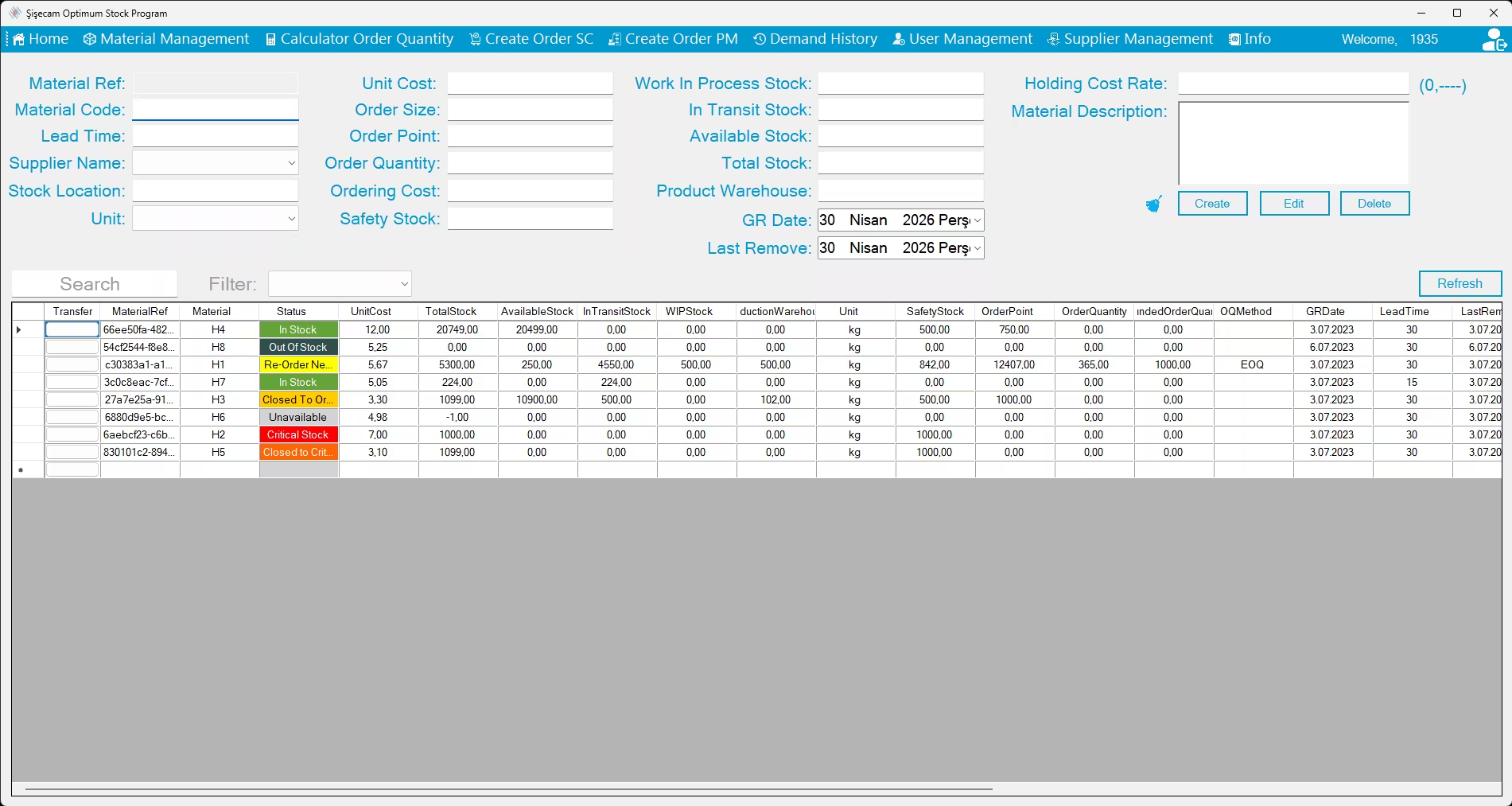
The material management screen is one of the core modules, where detailed product information is entered into the system. Because material dimensions and weights were outside the scope of the thesis, this information is not included in the system. For materials that have already been defined and calculated, the optimal order quantities and the calculation methods used are also shown to the user. This gives users fast, complete access to the critical planning information for each material.
Optimal Order Quantity Calculation Module
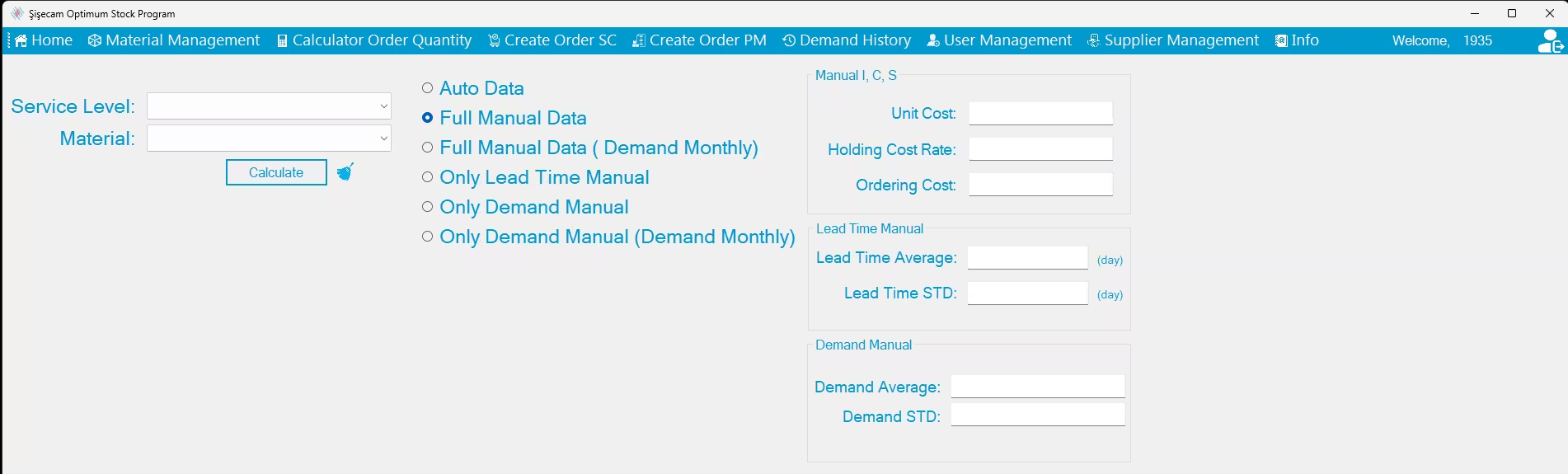
The program offers several ordering methods, including Economic Order Quantity, Single-Period Decision and Quantity Discounts. Based on your situation, the program selects the most suitable ordering method and shows you the order quantity. Every calculation method takes your lead times and demand or planned production quantities into account. Different cost calculation methods are also used in the background.
Economic Order Quantity (EOQ)
Taking your variable lead times and demand into account, the most economical order quantity is determined with statistical methods. Many costs, from ordering costs to holding costs, are included in this calculation. Constraints such as order lot size are also considered. Six separate options were created for different scenarios, so you can calculate the order quantity for a variety of situations.
Quantity Discounts
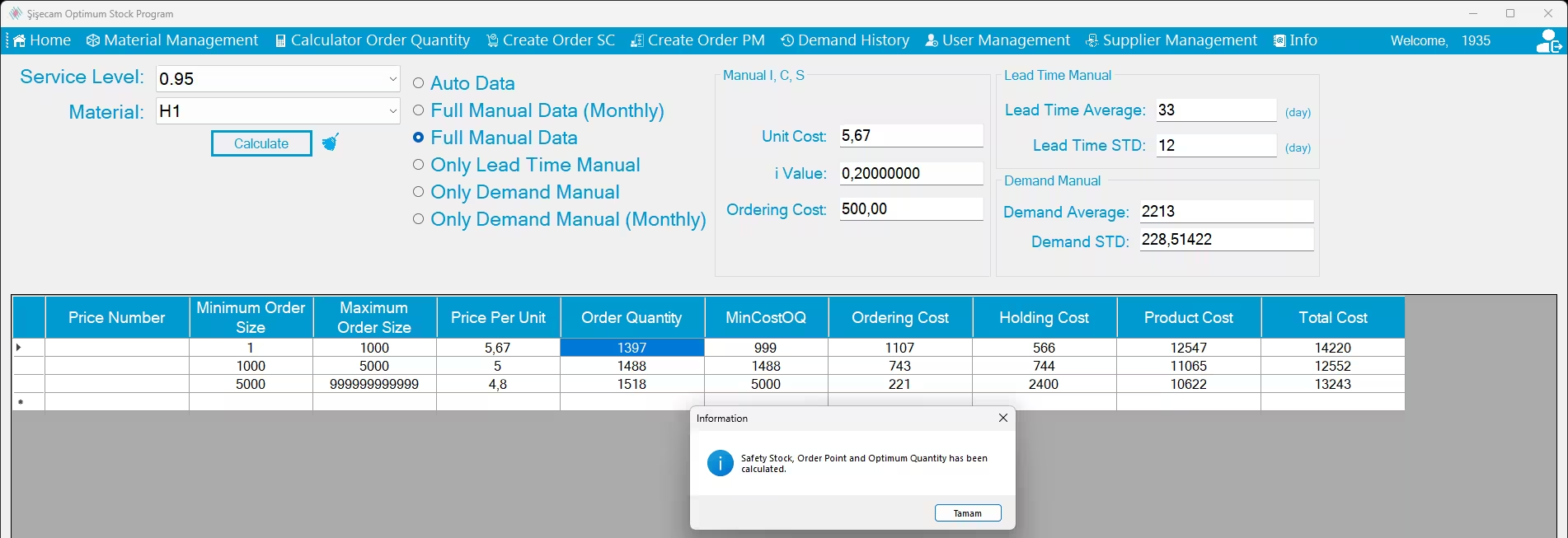
Your suppliers may offer different prices for different order quantities. By entering these quantity and price details, you can have the program calculate the most suitable order quantity. It analyzes the situation with scientific methods, runs cost calculations in the background and presents the optimal order quantity, taking every cost you enter into account. While companies run separate studies for these calculations, we get the results in seconds. The six options mentioned above can also be used with this method: your costs, demand, lead times and lot sizes are presented in technical detail for each of the six scenarios, so you can find the optimal order quantity for each price level.
Single-Period Decision (Newsvendor Model)
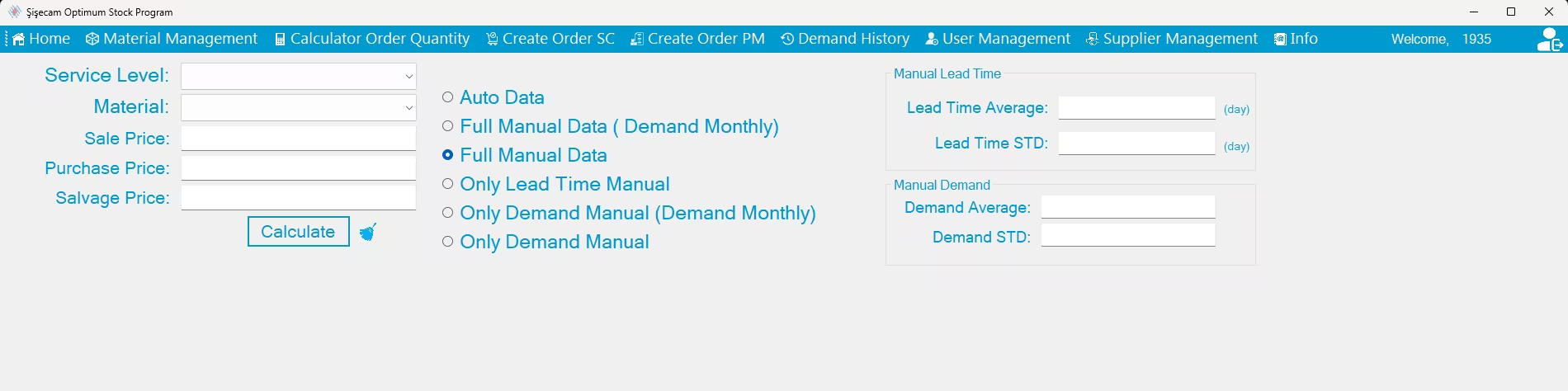
The program uses this method for perishable products or products with a limited shelf life. It determines the optimal order quantity by comparing holding costs with ordering costs. Inspired by the newsvendor problem, this method calculates the optimal order quantity for products with an expiry date.
Supply Chain Order Module
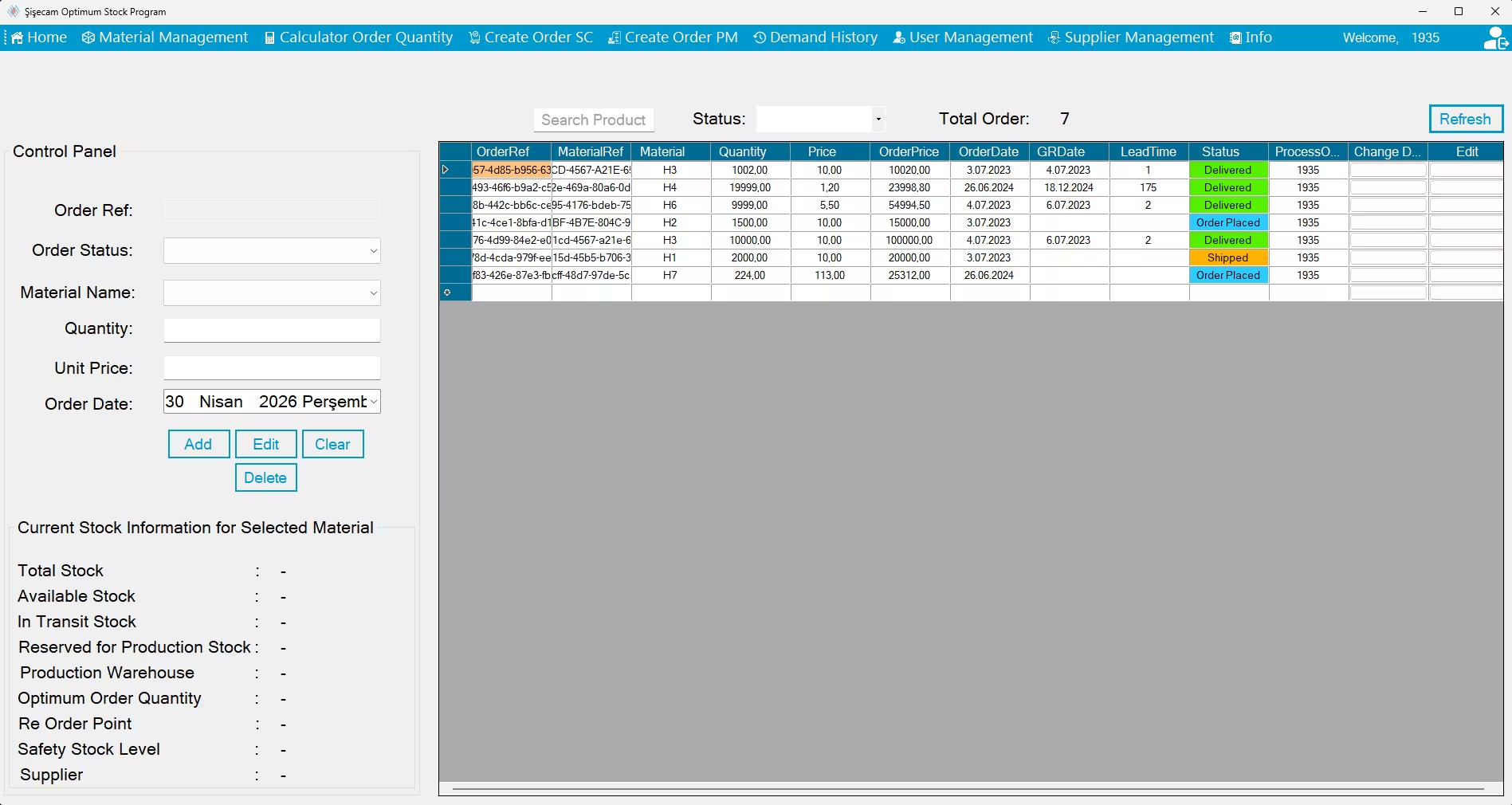
This system is designed to help the Supply Chain Department manage order creation efficiently and record lead times in detail. Orders created by the supply chain officer for each raw material are entered into the system, which then updates the stock information, records the order date and stores the data in the database. This recorded data is used to calculate optimal stock levels and the required lead times, using statistical measures such as the mean and standard deviation. When the material is received, the received quantity and date are entered and the order status changes from "ordered" to "shipped". In this way the system both tracks lead times and keeps stock receipts up to date.
Production Planning Order Module
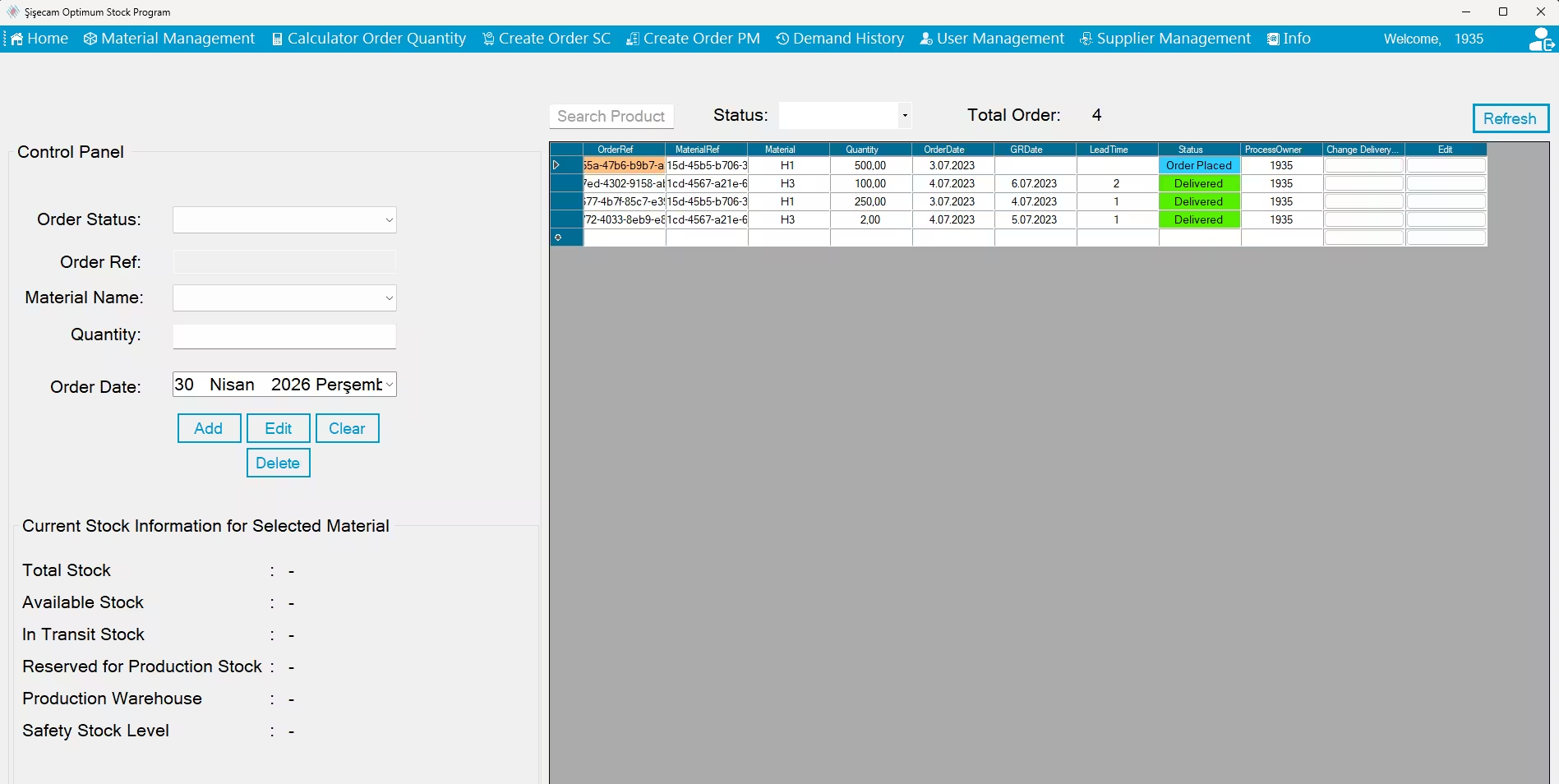
A dedicated interface was developed so that the Production Planning Department can use the materials supplied to the company efficiently. Through this page the production planning team can request specific quantities of the materials it needs for planned products from company stock. These requests can be viewed in real time by the Supply Chain Department, so supply planning can be carried out accordingly. This structure aims to improve cross-department coordination and make planning more effective.
Demand History Module
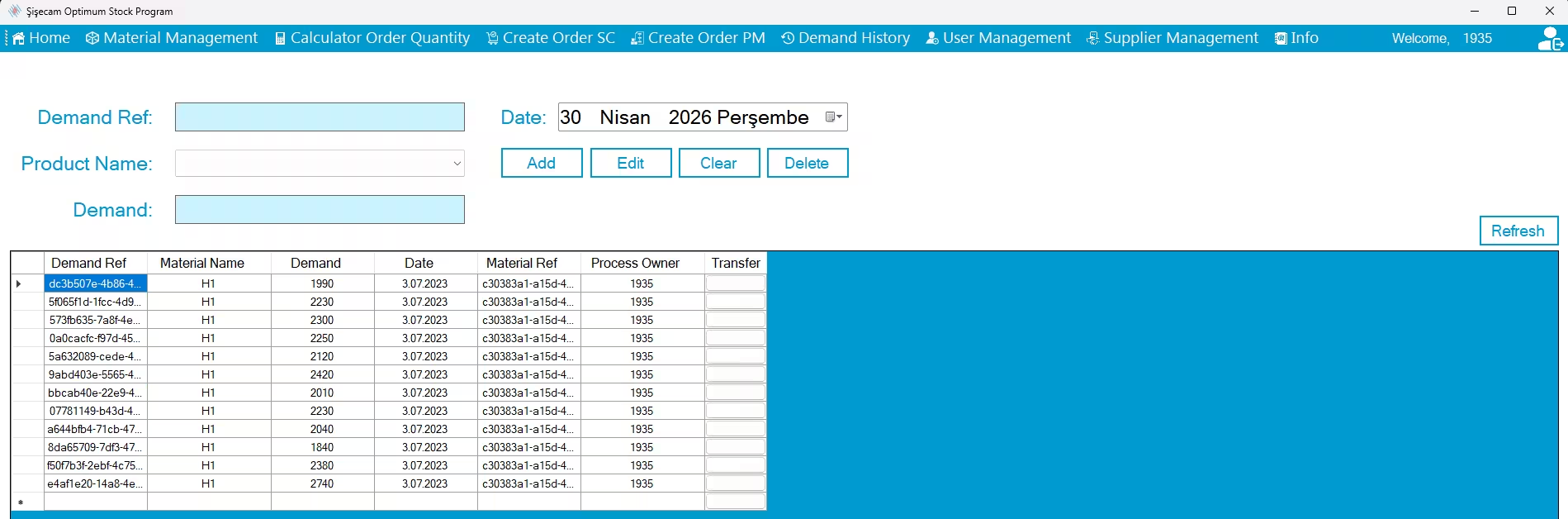
The demand history module lets users enter historical production data and the demand forecasts created by production planning. This data plays a critical role in determining optimal order quantities and improves the accuracy of the calculations. Users can manually enter large amounts of demand data, in particular monthly demand data for actively used materials. This data is an important input for the reorder point and safety stock calculations.
Supplier Management Module
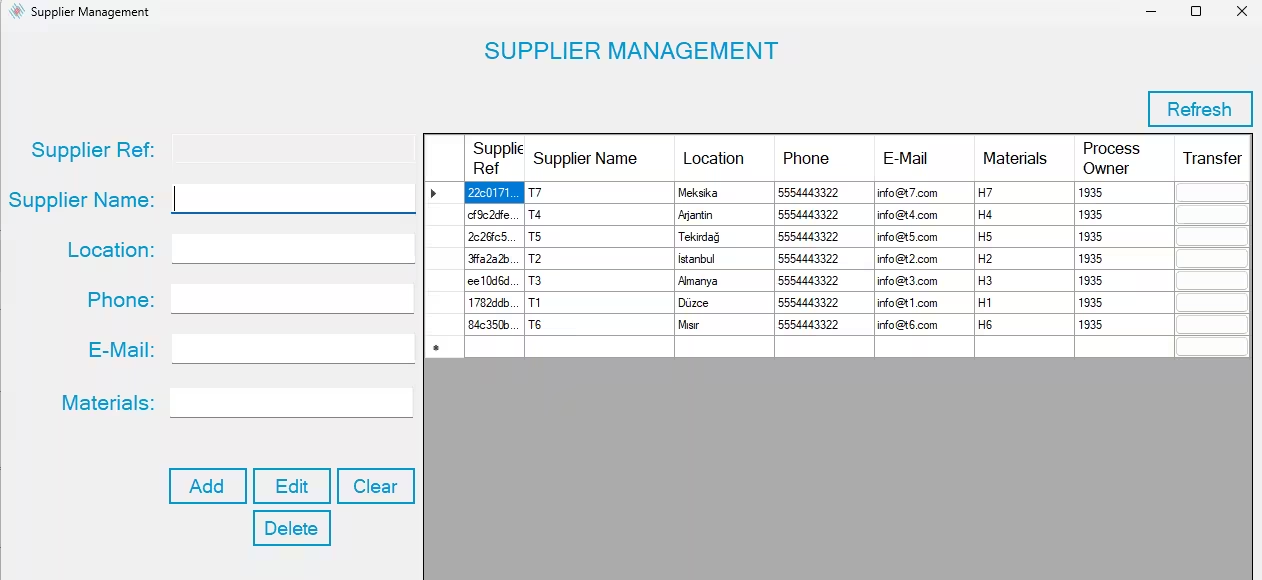
The supplier management module lets the company manage its suppliers systematically and track which materials are sourced from which suppliers. With the supplier evaluation system planned for this module, suppliers can be analyzed against specific performance criteria, including the quality of supplied materials, price level, defect rate, lead time and delivered quantity. Based on these criteria the system aims to compare suppliers, suggest alternatives and let the company work with the most cost-effective supplier, reducing dependence on a single supplier and creating a more flexible supply structure. The module already contains the underlying infrastructure for this goal.
Information and Contact Module
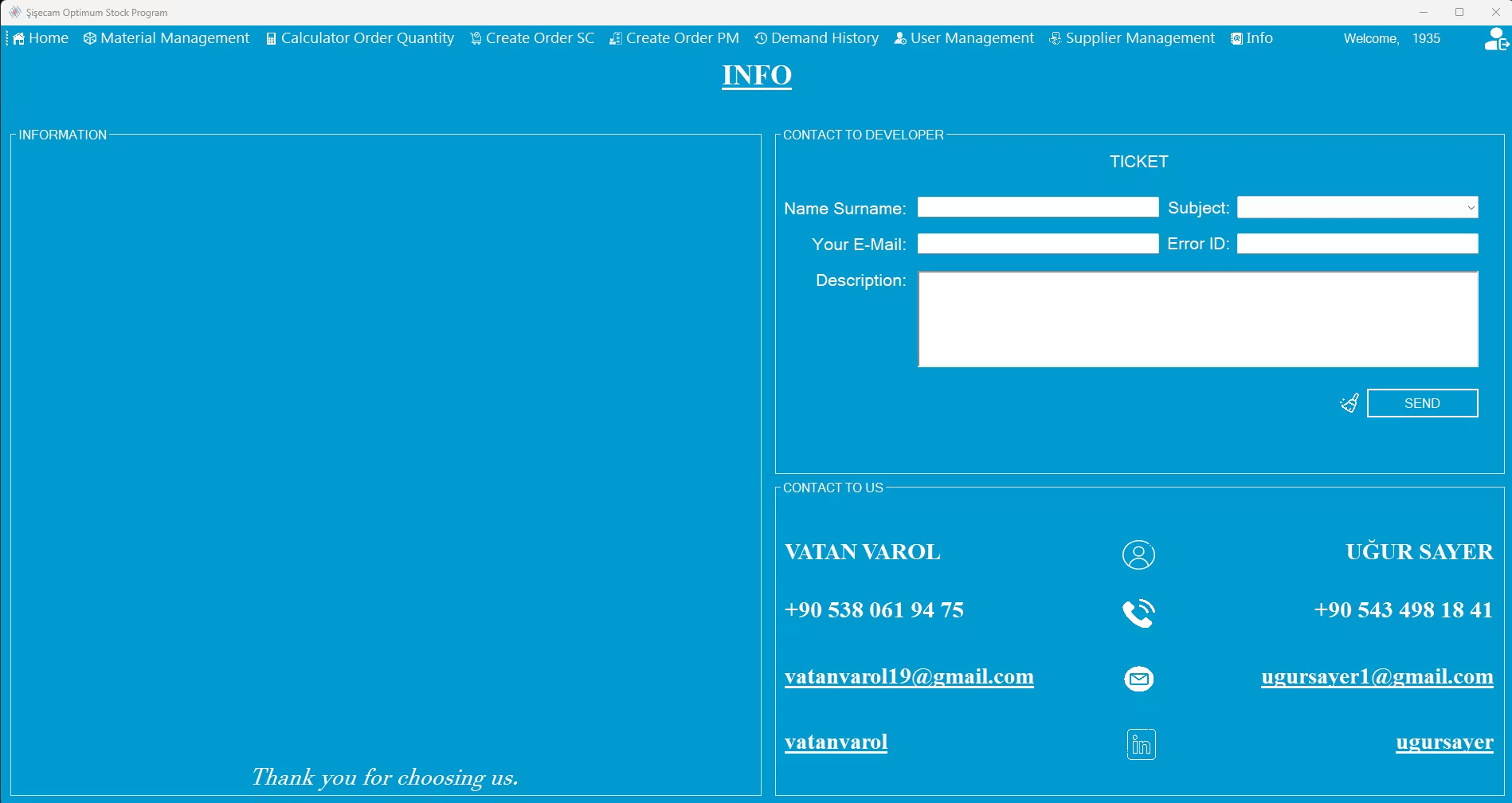
The information and contact page was created to give general information about the system and to collect user feedback. The system developers welcome users' opinions, suggestions and constructive criticism, and aim to build more advanced projects based on this feedback. In the long term, the goal is to develop innovative and transformative solutions in supply chain management.
Future Vision
Modules planned for later stages of this platform
- ERP / MRP Integration
- AI Demand Forecasting
- Warehouse Volume Optimization
- Warehouse Management & Planning
- Supplier Selection & Process Capability
- Cost Analysis Module
- BOM (Bill of Materials)
- Supply Chain & AI
Would you like to talk about this project or stock optimization?
All content, the software infrastructure and intellectual property rights belong to Vatan Varol & Uğur Sayer. No real company data is shared; the screenshots use representative data. It may not be used without prior written permission. © October 27, 2023