
Simplicity in Production Planning: How Do I Manage Complexity?
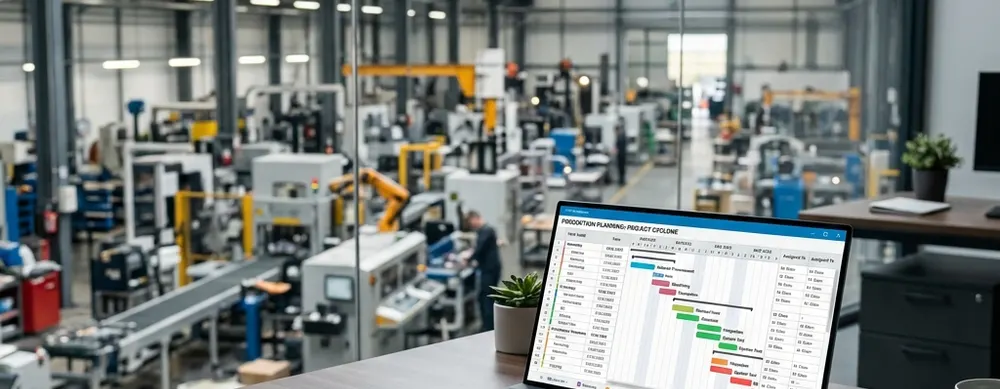
Industrial engineering and production planning usually bring to mind huge data tables, complex screens and endless meetings. But as a planning specialist, my approach has always been much clearer: "Less but better."
A factory floor is already busy and complex by nature. My real job at my desk is not to add new, hard-to-understand reports on top of that complexity, but to simplify the process until everyone on the floor can understand it at first glance.
I follow three basic rules to keep things simple in my own processes:
1. A Single Source of Truth
Data scattered across different places always leads to errors. That is why I put only our ERP system at the center of the work and manage stock and production data from a single screen. Planning is a process too: the more inputs that come into it from different places, the messier and more error-prone the output becomes.
2. Speaking the Shop Floor's Language
An operator on the floor does not need complex tables that took hours to build. What they need is a clear answer to the question "Which products will I make today, and in what order?" After finishing my work in the background, I send the floor a work list in the simplest, clearest form, containing just that answer.
3. Being Fast and Flexible
A perfect plan made at a desk can collapse the moment a machine breaks down on the floor. That is why planning has to be dynamic and flexible. Instead of building heavy, overly detailed systems, I prefer practical tracking methods that can adapt immediately to changing conditions.
"In short, for me the best production plan is not the one with the most formulas and data, but the one the people on the floor can understand and apply most easily. The best way to manage complexity is to simplify it."